
By means of subordination, a sentence complex is generated, in that one of the inflectional phrases (= subordinate clause) is not independent, but is a constituent of the other one (= main clause).
Such a sentence complex is always in the same grammatical subcategories as its main clause (see 15.a).
The subordinate clause appear in Persian in the following forms:
- 18.1 Relative clause. Such a subordinate clause attributes a phrase of the main clause (= attributive focus, see Chapter 10.):

Saadi (12th and 13th Century AD)
This type of subordination can be differentiated by means of its attributive focus (from the main clause), as well as a pronoun from the subordinate clause (= relative pronoun) referring to the same entity:

- 18.2 Content clause. This subordinate clause has no relative pronoun and plays (on the whole) the role of a constituent in the main clause:

Nasrollah Monshi (12th Century AD)
A content clauses refers to no attributive focus, but it can be deputized in the main clause by a demonstrative pronoun (as a placeholder):

- 18.3 Subordinate clause as prepositional or determinative focus. Inflectional phrases can also be used as focuses of a few prepositions and determiners:
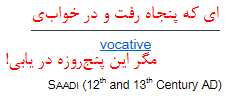
- 18.4 Adverbial clauses appear to be generated by evolution of the subordinate clause as prepositional focus, and can only have the role of an adverbial in the main clause. Adverbial clauses are applied without relative pronoun, without attributive focus and without placeholder:
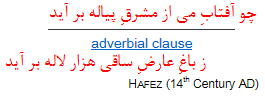
In Indo-European languages, a conjunction can be set in front of the (syndetical) subordinate clause which is usually generated by means of grammaticalization of a pronoun. As demonstrated in the examples above, in Persian this role is mainly fulfilled by the conjunction /ke/ که (from the interrogative pronoun /ke/ که).
The following interrogative pronouns are also grammaticalized to subordinative conjunctions:
- For the concessive clause the interrogative pronouns /ʧe/ چه and /ʧænd/ چند (see 18.4.f:):
اگر چه عرضِ هنر پیشِ یار بیادبیست
زبان خموش، ولیکن دهان پر از عربیست
Hafez (14th Century AD)
اگر چند فرزند چون دیو زشت
بود نزدِ مادر چو حورِ بهشت
Asadi Tusi (11th Century AD)
- The interrogative pronoun /ki/ کی in archaic varieties:
زیرا که آن سرایزذست کی بذآن آگاه کنذ آن کس را خواهذ از اولیاءِ او.
Abu Yaghub Sagzi (10th Century AD)
- Also in archaic varieties, the interrogative pronoun /koʤɒ/ کجا:
حکمت آبیست کجا مرده بدو زنده شود
حکما بر لبِ این آب مبارکشجرند
Nasir Khusraw (11th Century AD)
نگه کن کجا آفریدونِ گُرد
که از پیرضحّاک شاهی ببرد
برفت و جهان دیگری را سپرد
به جز حسرت از دهر چیزی نبرد
Ferdowsi (10th and 11th Century AD)
Additionally, (syndetical) adverbial clauses can also be accompanied by other conjunctions which are grammaticalized prepositions or adverbs (see 18.4).