| Contents |
|---|
a. Adjectives
Adjectives (category symbol: A) are lexical morphemes or affixal formations referring to features that can belong to entities:
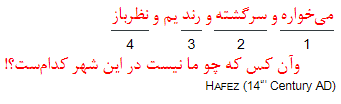
Within this definition, adjectives can be divided as follows:
- Free lexical morphemes: /bidɒr/ بیدار, /pæst/ پست, /zærd/ زرد
- Simple affixal formations: /næmɒjɒn/ نمایان, /ɒbi/ آبی, /nɒpɒk/ ناپاک
- Affixal formations whose stems are also affixal formations: /nɒbinɒ/ نابینا, /ærzɒntær/ ارزانتر
- Affixal formations which phrases serve as stems: /ʃæhr-e kordi/ شهرِکردی, /bisær-o-sedɒ/ بیسر و صدا
b. Adjectival Phrases
Adjectival phrase (category symbol: AP) is the genus for the language elements which refer to a character that can belong to (real or fictitious) entities. Adjectival phrases in Persian can have the following syntaxes:
- Simple adjectives: /særd/ سرد, /bimɒr/ بیمار, /tævɒnmænd/ توانمند, /puʃidæ/ پوشیده
- Adjectivized noun phrases: /ʃæjtɒn/ شیطان in /bæʧʧæ-je ʃæjtɒn/ بچّهیِ شیطان, /xær/ خر in diesem Beispiel:
سویِ خردمند زِ خر خرترست
هر که مر او را به ستوری رضاست
Nasir Khusraw (11th Century AD)
- Adjectivized non-finite verb forms: /pæsænd/ پسند, /xæstæ/ خسته
- Compounds:
- With the pattern [AP[APadjectival phrase] [NPnoun phrase]]: /bolænd-ɣæd/ بلندقد, /pɒk-del/ پاکدل
- With the pattern [AP[NPnoun phrase] [APadjectival phrase]]: /sær-zendæ/ سرزنده, /ʧeʃm-ɒbi/ چشمآبی
- With the pattern [NP[NPnoun phrase] [NPnoun phrase]]: /ræng-ræng/ رنگرنگ
- Phrases with the pattern [AP[DetPdeterminative phrase] [APadjectival phrase]]: /kæm-i æbri/ کمی ابری, /besjɒr bozorg/ بسیار بزرگ, /hær ʧe tæmɒmtær/ هر چه تمامتر
- Phrases with conjunctions as constituents,with the pattern [AP[APadjectival phrase] [Conconjunction] [APadjectival phrase]] (with one or more sequences of [Conconjunction] [APadjectival phrase]): /loxt o pati/ لخت و پتی, /dur-e dur-e dur/ دورِ دورِ دور in the following example:
معلوم شود چو پردهها بر دارند
کهاز کویِ تو دورِ دورِ دور افتادند
Omar Khayyam (11th and 12th Century AD)
- Phrases with the pattern [AP[APadjectival phrase] [PPadpositional phrase]]: /mehrbɒn bɒ kudakɒn/ مهربان با کودکان, /læb-riz æz eʃɣ/ لبریز از عشق
- Phrases with the pattern [AP[PPadpositional phrase] [APadjectival phrase]]: /æz mæn bozorgtær/ از من بزرگتر
In addition, there are some patterns that are only used for the attribution of nomina patientis and nomina agentis.
The following two special forms of adjectival phrases are handled in dedicated chapters:
In present chapter, general and common fetures of adjectival phrases are discussed.
c. Grammatical Categories of Adjectival Phrases
Adjectival phrases (and therefore also simple adjectives) have the following grammatical categories:
c.a Degree of Adjectival Phrases
The grammatical category degree of an adjectival phrase indicates the relative size of the feature expressed with the adjectival phrase.
The degree has the following subcategories in the Persian language:
- The positive is the basic level of the adjectival phrase: /xoʃk/ خشک, /færɒvɒn/ فراوان, /sæxt-ʤɒn/ سختجان
- The comparative (primarily in archaic varieties of Persian) indicates an adjectival phrase that (compared with a reference value) have a higher degree of a feature.
Adjectival phrases in the positive can be transferred into the comparative using the inflectional suffix /-tær/: /xoʃktær/ خشکتر, /færɒvɒntær/ فراوانتر, /sæxt-ʤɒntær/ سختجانتر
However, there are adjectival phrases in the comparative without the inflectional suffix /-tær/. These are /æfzun/ افزون, /fozun/ فزون, /beh/ به, /biʃ/ بیش, /ziɒdæ/ زیاده, /kæm/ کم, /keh/ که and /meh/ مه.
Even these adjectival phrases are normally used with the inflectional suffix /-tær/: /æfzuntær/ افزونتر, /fozuntær/ فزونتر, /behtær/ بهتر, /biʃtær/ بیشتر, /ziɒdætær/ زیادهتر, /kæmtær/ کمتر, /kehtær/ کهتر and /mehtær/ مهتر
The reference value of the adjectival phrase in the comparative can be set as an origative adverbial after (or occasionally in front of) the adjectival phrase to attribute ↓ it: /xoʃktær æz diruz/ خشکتر از دیروز, /færɒvɒntær æz næft/ فراوانتر از نفت, /æz mɒ sæxt-ʤɒntær/ از ما سختجانتر
- The superlative refers to the supreme extent of the feature that is expressed by the adjectival phrase compared with all elements in the superset.
This sub-category of the degree has the following syntax in the Persian:
- From adjectival phrases in the comparative, using the inflectional suffix /-in/: /xoʃktærin/ خشکترین, /færɒvɒntærin/ فراوانترین, /sæxt-ʤɒntærin/ سختجانترین, /behin/ بهین, /kæmin/ کمین
- Rarely also from adjectival phrases in the positive, using the inflectional suffixes /-æst/, /-est/, /-æʃt/ and /-eʃt/. These suffixes are no longer present in the contemporary varieties of Persian: /mehest/ (/mæhæst/) مهست, /beheʃt/ بهشت
نخستین سرِ نامه گفت از مهست /mæhæst/
شهنشاه کسرایِ یزدانپرست
Ferdowsi (10th and 11th Century AD)
In Persian, adjectival phrases in the superlative are not connected to the noun phrase adjectival, but rather in determinativized function: /zibɒtærin ʃæhr/ زیباترین شهر, /ʃoluɣtærin xiɒbɒn/ شلوغترین خیابان
In addition, nominalized adjectival phrases in the superlative can become nuclei of the partitive genitive, and appear with modifiers in the plural: /zibɒtærin-e ʃæhrhɒ/ زیباترینِ شهرها, /ʃoluɣtærin-e xiɒbɒnhɒ/ شلوغترینِ خیابانها
- The elative refers to the greatest possible size of a feature, without comparing it with other instances.
Adjectival phrases in the elative have the following pattern in Persian: [AP[DetPelative pronoun /hær ʧe/] [APadjectival phrase in the comparative]]
آرزو میکنم هر چه بیشتر /hær ʧe biʃtær/ (= as much as possible) با من باشند.
Mohammad-Ali Jamalzadeh (19th and 20th Century AD)
به حرمتی هر چه تمامتر /hær ʧe tæmɒmtær/ (= as complete as possible) و به عزمی هر چه صادقتر /hær ʧe sɒdeɣtær/ (= as truthful as possible) کشتیها را به طرفِ حصار راندند.
Owfi (12th and 13th Century AD)
کار نیشاپور در عهدِ ریاستِ او نظامی هر چه تمامتر /hær ʧe tæmɒmtær/ (= as complete as possible) گرفت.
From the book “ترجمهیِ تاریخِ یمینی” (13th Century AD)
دور بودن زِ چنان روی غمیست
هر چه دشوارتر /hær ʧe doʃvɒrtær/ و هر چه بتر /hær ʧe bætær/
Farrukhi Sistani (10th and 11th Century AD)
c.b Polarity of Adjectival Phrases
The grammatical category polarity of an adjectival phrase indicates whether the expressed feature is valid or not. This category has two sub-categories in Persian:
- An adjectival phrase is affirmative if the expressed feature is valid: /bærɒzændæ/ برازنده, /kutɒh/ کوتاه, /tɒrik/ تاریک
- If the feature that is expressed by an adjectival phrase is invalid, the adjectival phrase is negative. The negative polarity can be noted in Persian in the following cases:
- Affirmative adjectival phrases can become negative using the prefix /nɒ-/: /nɒʃenævɒ/ ناشنوا, /nɒhæmɒhæng/ ناهمآهنگ, /nɒʤur/ ناجور
- By means of adjectivization of negative perfect and present participles (with the prefixes /næ-/ and /nɒ-/) respectively, negative nomina patientis and simple nomina agentis can be generated:
/nægoftæ/ نگفته, /nɒdidæ/ نادیده
/næpæz/ نپز, /næfæhm/ نفهم, /nɒtævɒn/ ناتوان, /nɒdɒn/ نادان
- Affirmative adjectival phrases beginning with the proclitical adverb /mi-/ می can become negative with the prefix /næ-/, for example nomina agentis in the Tajik variety (see the article of Firuza Amanova in مجلهء زبانشناسی, 15th and 16th issue, page 7):
مردم به سخنِ او باور نمیکردگی /næmeː-kærdægi/ شدند.
- If an affirmative adjectival phrase acts as a modifier of possessive genitive and attaches to the nominal differential pronoun /ɣæjr/ غیر (see 7.4.b), it becomes negative (see 10.4.c): /ɣæjr-e osuli/ غیرِ اصولی, /ɣæjr-e mænteɣi/ غیرِ منطقی
d. Determinative Gradation of Adjectival Phrases
Gradation is the assigning of a feature to an adjectival phrase in gradual steps.
The most important method of gradation is the degree. Another possibility of grading is the application of determinative phrases (with the pattern [AP[DetPdeterminative phrase] [APadjectival phrase]]):
خیلی زیاد /xæjl-i ziɒd/
کمی ابری /kæm-i æbri/
بسیار سرد /besjɒr særd/
اندکی بیشتر /ændæk-i biʃtær/
پنج کیلومتر دورتر /pænʤ kilumetr durtær/
هوا بس ناجوانمردانه سرد [AP[DetP[DetP/bæs/] [AP/nɒʤævɒn-mærdɒnæ/]] [AP/særd/]] است
Mehdi Akhavan-Sales (20th Century AD)
Grading determinative phrases can have several syntaxes in Persian:
- Determinativized adverb phrases:
کاملاً درست [AP[DetP[AdvP/kɒmelæn/]] [AP/dorost/]]
نسبتاً کوتاه [AP[DetP[AdvP/nesbætæn/]] [AP/kutɒh/]]
تا همی خندی همی گریی و این بس نادرست
هم تو معشوقیّ و عاشق، هم بتیّ و هم شمن
Manuchehri (10th and 11th Century AD)
- Determinativized adjectival phrases:
ناجوانمردانه سرد [AP[DetP[AP/nɒʤævɒn-mærdɒnæ/]] [AP/særd/]]
بسیار طولانی [AP[DetP[AdvP/besjɒr/]] [AP/tulɒni/]]
- Measure word numerals:
ده متر بیشتر [AP[DetP/dæh metr/] [AP/biʃtær/]]
دو روز بعد [AP[DetP/do ruz/] [AP/bæʔd/]]
Other Measure word numerals belong to this group (siehe 6.1.4.a), like:
- /sɒlhɒ/ سالها in /sɒlhɒ piʃ/ سالها پیش
- /xæjl-i/ خیلی in /xæjl-i ziɒd/ خیلی زیاد
- /jek kæm-i/ یک کمی in /jek kæm-i bolændtær/ یک کمی بلندتر
- /bæs-i/ بسی in archaic varieties, for example in /bæs-i tɒzetær/ بسی تازهتر:
حقّا! که بسی تازهتر و نوتر از آنید
من نیز از این پس ننمایمتان آزار
Manuchehri (10th and 11th Century AD)
e. Prepositional Attribution of Adjectival Phrases
Adjectival phrases can be attributited by prepositional phrases, and the attribute can be set after (or occasionally in front of) the adjectival phrase: /bɒlɒtær æz siɒhi/ بالاتر از سیاهی, /pæs æz nɒhɒr/ پس از ناهار, /æz xod bixod/ از خود بیخود, /hæmrɒh bɒ to/ همراه با تو
This Attribution can be noted, amongst others, with adjectival phrases in the comparative. Other interesting aspects are explored in the following chapters:
f. Focus Shifting of Adjectival Phrases
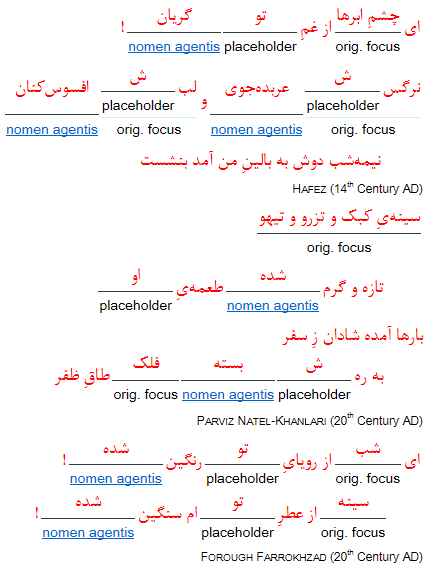
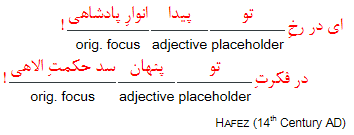
A characteristic of Persian language is the ability of the original focus (= the entity described by the adjectival phrase) to also attribute the adjectival phrase. In this case, the attributed adjectival phrase focuses on another entity which is represented in the adjectival phrase by a placeholder (in the form of a personal or possessive pronoun, cf. 15.d Placeholder in Dislocation and 18.2 Placeholder of Content Clause):
Such complex attributions would be more commonly expected in Persian with nomina patientis and agentis (see 4.1.b and 4.2.b). In fact, this focus shifting can often be found in nomina agentis: