
The person grammatical category of a verb phrase indicates whether an action or a situation is assigned to the speaker or the addressees. The following subcategories of the person are relevant in Persian, like in most languages:
- The action or the situation expressed by a verb phrase in the 1st person is assigned to the speaker: /xæridæm/ خریدم, /mi-bæxʃim/ میبخشیم
- The subcategory 2nd person indicates that the action or the situation is assigned to the addressees, but not to the speaker: /istɒdi/ ایستادی, /mi-dɒnid/ میدانید
- All other verb phrases are in the 3rd person: /kærdænd/ کردند, /mi-binænd/ میبینند
a. Syntax
The person of conjugated Persian verb phrases is determined by the following constituents:
- Suppletive verbs for conjugated perfect and presumptive participles:
بادهیِ خاص خوردهای (2nd person)، نُقلِ خلاص خوردهای (2nd person)
بویِ شراب میزند، خربزه در دهان مکن!
Rumi (13th Century AD)
سالها وضعِ بلاها کردهایم (1st person)
وهم حیران زآن چه ماها کردهایم (1st person)
Rumi (13th Century AD)
- Verbal inflectional suffixes for conjugated past and present participles:
دل بنهند (3rd person) بر کنی (2nd person)، توبه کنند (3rd person) بشکنی (2nd person)
این همه خود تو میکنی (2nd person)، بی تو به سر نمیشود (3rd person)
Rumi (13th Century AD)
In Persian, verb phrases which are not conjugated in a certain subcategory of person can only be noted in the application of perfect participle as predicate (in copulative coordination of inflectional phrases) (see 12•4•b.):
نامه را نوشته (1st person) به صندوق انداختم!
b. Verbal Concord and Discord in the Person
(See 13•5•b. Verbal Concord and Discord in the Polarity and 13•6•b. Verbal Concord and Discord in the Number.)
Verbal concord in the person means that the subject (a noun phrase) and the predicate (a verb phrase) are in the same person subcategory in a sentence:
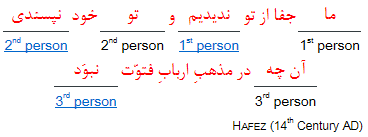
As previoulsy discussed in Chapter “verbal discord in the number”, the following pronouns appear in Persian in the 3rd person singular, while the predicate conforms to the number and the person of the superset and can cause a verbal discord:
- Distributive pronouns (see 7•8•b•a.):
هر یک از راهِ دیگری برایِ سرافرازیِ کشور تلاش میکنیم.
هر کدامتان داستانی دیگر برایم تعریف میکنید.
- Inexistential pronouns (see 7•10•b.):
هیچ یک پاسخی به این پرسش نداشتیم.
هیچ کدام دچارِ بیخوابی نیستید.
- Selective pronouns (see 7•11.):
باید یک کدام این خبر را به او بدهیم.
یک کدامتان او را لو دادهاید.
However, the predicate becomes concordant (in the 3rd person singular), if the superset attributes the pronoun as an origative adverbial:
باید یک کدام از ما این خبر را به او بدهد.
از شماها یک کدام او را لو داده است.
هر یک از ما ایرانیان از راهِ دیگری برایِ سرافرازیِ کشور تلاش میکند.
هر کدام از شما داستانی دیگر برایم تعریف میکند.
هیچ یک از ما فرزندان پاسخی به این پرسش نداشت.
هیچ کدام از شما دختران دچارِ بیخوابی نیست.